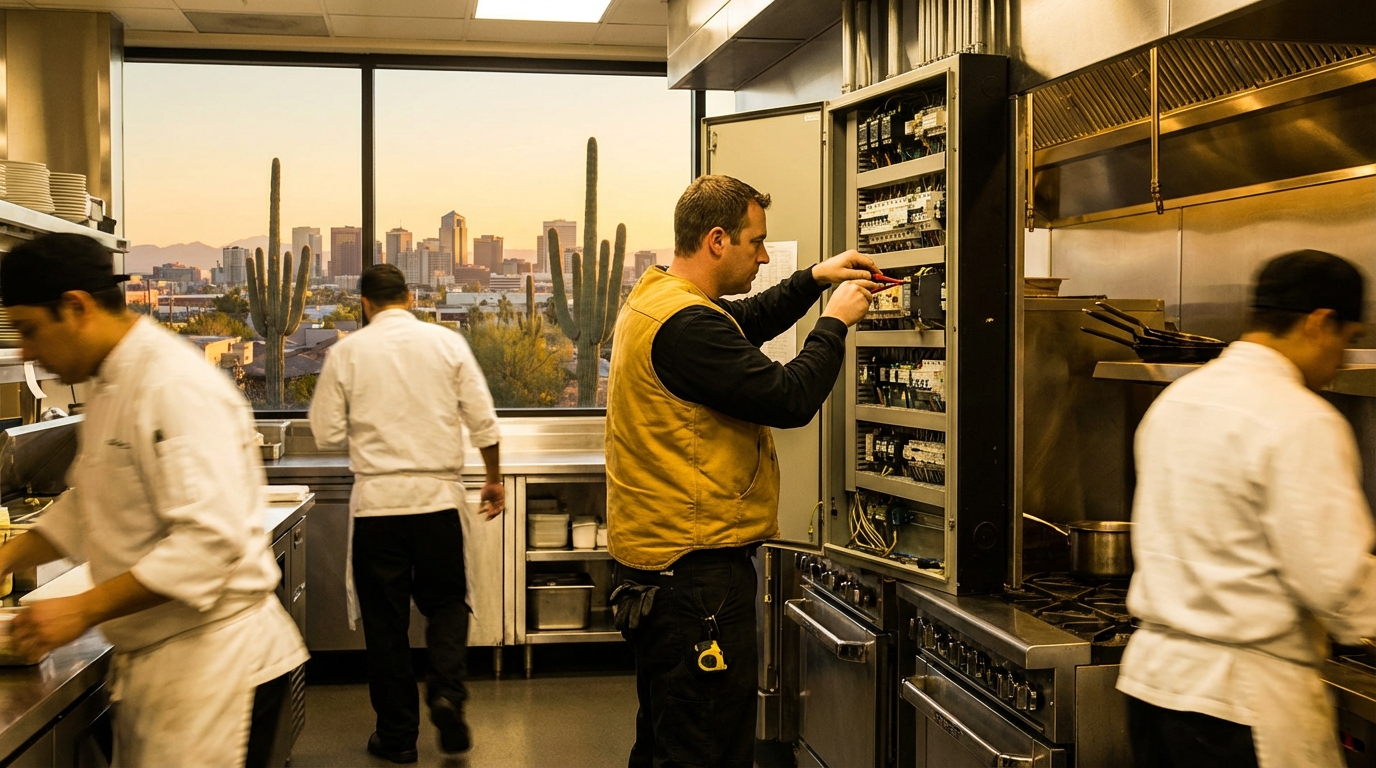
If you run a restaurant kitchen in the desert heat of Arizona, you need reliable power every single day. That is why local Phoenix electricians matter so much for restaurant kitchens: they keep your equipment safe, your food at the right temperature, and your staff working without constant interruptions from tripped breakers or dead outlets.
That sounds simple, but it gets complicated fast once you look behind the scenes. Commercial kitchens pull a huge amount of power, and they do it in a tight space, with people moving quickly, water on the floors, hot oil, gas lines, and constant pressure to push out plates. One loose connection or badly loaded circuit in that setting is not just annoying. It can ruin service or damage equipment, and in some cases, it can be dangerous.
Why restaurant kitchens are tough on electrical systems
Home kitchens and restaurant kitchens are not in the same league. A home oven might run a few hours a day. A restaurant line uses ovens, fryers, salamanders, microwaves, heat lamps, refrigerators, freezers, dish machines, POS systems, and fans, often all at once. Those loads add up very fast.
A restaurant kitchen is basically a small power plant that never really rests during service hours.
In Phoenix, there is another layer: the heat. The outside temperature can reach levels that put extra stress on electrical panels, rooftop units, and wiring that runs through hot spaces. I think many owners underestimate that part. They focus on air conditioning or walk-in refrigeration and forget that the wiring feeding all of this also lives in that same harsh environment.
That is where a local electrician who understands Phoenix conditions can make a real difference. Not just any electrician, but someone who deals with food service setups again and again.
Heat, humidity, and grease: a tough mix
Restaurant kitchens deal with heat from cooking, steam from dishwashers, and a lot of airborne grease. That combo is not friendly to electrical gear.
- Heat raises the temperature in panels and junction boxes.
- Humidity and steam can creep into outlets and fixtures.
- Grease film can coat switches, fans, and even some connections.
If wiring is not protected properly, or if components are not rated for that environment, you start to see problems: corroded connections, cracked insulation, nuisance tripping, or failures at the worst moment.
I remember a chef telling me about a busy Friday where the line lost half their outlets on the hot side. The electrician later found that a junction box above the hood was packed with grease vapor and moisture. The connections had weakened over time. Nothing dramatic, no sparks or flames, just a slow breakdown that finally tipped over during a rush.
Most electrical failures in kitchens do not come from one big mistake. They come from small shortcuts stacked over years.
High power loads and constant cycling
Another quiet problem is how often equipment starts and stops. Refrigeration compressors, dish machines, mixers, and other gear cycle on and off a lot. This cycling creates inrush currents that hit your wiring and breakers over and over. A design that might look fine on paper for steady loads can struggle when the equipment is constantly switching.
Good Phoenix electricians who work with restaurants take this into account. They size circuits, panel capacity, and breaker types to handle real kitchen behavior, not just theoretical averages.
What a Phoenix electrician actually does for a kitchen
Some people think of electricians as the ones who just show up when the lights go out. That is one part of the job, but for restaurant kitchens, the helpful work usually happens before something breaks.
Planning and layout during build or remodel
If you are opening a new restaurant or remodeling, the electrician has a big say in how your kitchen feels to work in. They help decide where outlets go, how many circuits you have on each wall, how the line is separated from prep, and how much power is reserved for future equipment upgrades.
A thoughtful electrical layout can make daily work smoother:
- Enough outlets so staff are not daisy chaining power strips.
- Separate circuits for critical refrigeration and POS gear.
- Dedicated lines for heavy equipment like combi ovens or large mixers.
- Logical labeling on panels so a trip can be fixed quickly.
Have you ever seen a prep table with six appliances plugged into one outlet bar, with cords crossing a walkway? That is the kind of thing a good electrician helps you avoid before it starts.
Making sure you meet local codes and fire rules
Restaurants are held to strict electrical and fire standards. In Phoenix, you have city codes, state requirements, and often extra demands from landlords, health inspectors, or insurance companies.
A kitchen must have:
- Proper GFCI protection in wet or near-sink areas.
- Correct wiring and disconnects for hood systems and make-up air.
- Correct clearances around panels and electrical rooms.
- Emergency lighting and exit signs on reliable power.
Some of these are not obvious if you are a chef or an owner focused on food. You might place a storage rack in front of a panel without thinking, or you might plug an extra freezer into a circuit already near its limit, just because the outlet is handy.
A restaurant kitchen that passes its opening inspection can still drift out of compliance slowly, one small decision at a time.
Regular visits from a trusted electrician help catch those slow drifts before they turn into a failed inspection or, worse, a safety issue.
Common electrical mistakes in restaurant kitchens
I want to go through a few recurring issues that come up in real kitchens. You might recognize some of them if you work back of house or manage a place.
Overloaded circuits from “temporary” fixes
Temporary fixes have a way of becoming permanent. A sous chef brings in an extra induction burner during a menu change. Someone adds a small freezer, just for weekends. A countertop oven appears for brunch service.
Each new item finds an outlet. No one thinks much about where that outlet ties into the panel. The breaker does not trip, so people assume it is fine.
Until a busy night when multiple pieces draw full power at once, and suddenly half the line goes dark.
| Situation | What often happens | Better approach |
|---|---|---|
| New small appliance added | Plugged into nearest outlet, circuit load unknown | Electrician checks circuit capacity before permanent use |
| Seasonal equipment (holiday, events) | Extension cords run across floors or above ceilings | Plan dedicated outlets or temporary circuits with safe routing |
| Multiple appliances on power strips | Power strip used as a permanent solution | Install extra dedicated receptacles |
This is where a Phoenix electrician can be blunt and helpful at the same time. They can look at your planned equipment changes and say, “Yes, that is fine on this wall, but not that one,” or, “You need one more circuit here if you want to keep adding heat on the line.”
Ignoring panel capacity and future growth
Restaurant concepts change. Menus evolve. A simple grill house might later add a bakery program or a serious cocktail bar with its own ice machines and equipment.
If the original panel is already close to full, each new piece of gear turns into a hard discussion. Sometimes you can shift loads or add sub-panels. Other times, the building simply needs more capacity.
Planning a bit of extra capacity at the start can save a lot of pain later. I know that is hard when build-out costs are rising and every line item feels heavy. Still, trying to run a modern kitchen on undersized service often leads to service calls at the worst time and higher costs over the long run.
Mixing water and power in unsafe ways
Kitchens are wet areas. Sinks splash. Floors get hosed. Steam hangs in the air near dish machines.
Problems appear when outlets are placed too close to constant moisture, or when equipment that is meant to be portable ends up living in a puddle-prone spot. You see extension cords running under mats near sinks, or small fridges tucked into damp corners.
A local electrician can move outlets, add GFCI where it is missing, and protect wiring from this kind of wear. They also know, from other jobs, where issues usually show up: under dish tables, behind ice machines, near mop sinks, and in outdoor prep or bar areas.
Why Phoenix matters in this conversation
You might ask, why do we keep saying “Phoenix electricians” instead of just “electricians”? The city and its climate really do change the equation a bit.
Extreme heat on roofs and outside walls
Rooftop units, walk-in condensers, and feeder conduits on exterior walls get hit hard by Phoenix sun. That heat can raise wire temperatures, age insulation faster, and stress connections.
Electricians who work here every day know to account for that:
- Using conductors sized correctly for ambient temperature.
- Protecting conduit runs from direct sun where possible.
- Checking rooftop junction boxes more often in maintenance visits.
A panel or disconnect that might be fine in a milder climate can struggle when metal surfaces are already hot before any equipment turns on.
Heavy air conditioning loads sharing service
Restaurants in Phoenix usually have strong air conditioning systems. Those systems draw big chunks of power, especially in late afternoon and early evening when some dinner services start.
If the building service size is tight, and HVAC and kitchen loads peak together, you can see nuisance trips or voltage drops that affect sensitive equipment like POS systems or some digital controls.
A good electrician will coordinate with HVAC teams to balance phases, time delays, and starting currents. It is not something most owners want to think about, but it has real daily impact. Have you ever had your POS screens flicker when the AC kicks on? That is the kind of thing that comes from poor coordination.
Older buildings in growing neighborhoods
Phoenix has many shopping centers and older strips now being converted into restaurants. Those buildings were not always designed for heavy kitchens. The wires, panels, and grounding systems might be decades old.
Converting a former retail spot into a restaurant means:
- Evaluating existing panels and feeders for real capacity.
- Checking grounding and bonding for safety.
- Upgrading outlets and circuits to current codes.
Some owners hope to keep as much as possible “as is” to save money. I get the impulse. Still, cutting corners on the electrical retrofit can come back later in the form of failures during service, or inspections that delay opening day.
How good electrical work supports food quality and service
So far, this might sound like a conversation only for contractors and facility managers. But if you are a chef, cook, or restaurant owner, the electrical setup touches your daily work in very direct ways.
Stable temperatures in refrigeration
Refrigerators and freezers in a restaurant are not like home fridges. They open constantly. They restock from deliveries. They stand next to hot cooking equipment in some layouts.
If circuits are unstable or overloaded, even brief power dips can stress compressors. Over time, that can lead to breakdowns. When a walk-in fails, food safety is at risk. Staff scramble to move product. Service suffers.
Electricians help by:
- Putting key refrigeration on dedicated circuits.
- Labeling those breakers clearly so staff can act fast when something trips.
- Occasionally wiring alarms or monitoring devices, if the restaurant chooses that route.
Some places go further and run critical refrigeration on separate panels with extra protection. That kind of planning starts with an electrician who understands what happens to food when equipment fails at 7 p.m. on a Saturday.
Reliable cooking equipment during peak hours
Line cooks depend on consistent power for electric ovens, induction burners, fryers with electronic controls, and holding units. When power is weak, recovery times stretch out, and food quality can drop without anyone noticing at first.
For example, if an underpowered circuit feeds both a fryer and a holding cabinet, a heavy fry run might drop voltage enough that the cabinet struggles to stay at temp. Food sits just a bit cooler than it should. No alarm, no obvious sign, but quality shifts.
A thoughtful electrician separates heavy loads, balances phases, and checks voltage under load during commissioning. It sounds technical, but the effect is simple: when tickets pile up, your gear still behaves as expected.
Lighting that supports both safety and mood
Front-of-house lighting gets more attention, but back-of-house lighting matters for both safety and speed. Poorly lit prep tables lead to mistakes, slow knife work, and more strain on staff.
Electricians can:
- Install bright, neutral lighting over prep and dish areas.
- Separate lighting zones so line cooks can have more light than the expo pass if desired.
- Add emergency lights and exit signs that stay on when power fails.
I once walked through a kitchen where half the fluorescent fixtures had failed over time. People just got used to working in the dim light. When they finally had an electrician replace fixtures and move to LED, the staff reaction was almost funny. Knife work got easier overnight. That is not a “tech” story, it is a basic human comfort story.
Maintenance habits that keep your kitchen running
Even the best electrical installation needs care. Wires loosen, grease creeps, labels fall off panels, and equipment load patterns change.
Regular checkups instead of emergency calls
Think about how you treat your hood cleaning. You schedule it. You plan around it. You know that if you skip it, you risk both fire and failed inspections.
Your electrical system benefits from a similar mindset. Not the same frequency, of course, but a recurring check.
- Panel inspections and tightening of connections.
- Infrared scans to spot hot spots on breakers or lugs.
- Testing of GFCI outlets and breakers.
- Review of any “temporary” cords or setups that turned permanent.
Many issues show subtle signs before they fail. Breakers feel warm, faint buzzing noises appear, or outlets spark lightly when plugging in. A busy kitchen might ignore those signs until something stops working.
If the first time an electrician sees your panel is during a Friday night failure, you are already behind.
Training staff on simple electrical awareness
Your team does not need to be experts, but a little awareness goes a long way. Things like:
- Not overloading power strips or stacking adapters.
- Keeping cords off hot surfaces and out of standing water.
- Reporting frequent breaker trips instead of resetting forever.
- Knowing which breaker controls which critical piece of equipment.
An electrician can help label panels clearly and walk a manager through the basics. That small step can reduce panic when a circuit trips and buy you time until a qualified person arrives.
Choosing the right electrician for a Phoenix restaurant
Not every electrician is a good match for a restaurant. Some focus mainly on houses, or on large industrial projects. You want someone who works with commercial kitchens regularly, in Phoenix conditions.
Questions to ask before you hire
- How many restaurant or commercial kitchen projects have you done locally?
- Are you familiar with local health and fire inspection concerns for kitchens?
- How do you handle after-hours or emergency service?
- Can you help plan for future equipment expansion, not just current loads?
- Will you provide clear panel schedules and labeling when the job is done?
You do not need to accept vague answers. If someone cannot describe common kitchen problems they have solved, they might not have enough experience with your type of space.
Balancing cost and reliability
Electrical work is not cheap. There is labor, material, permits, and sometimes service upgrades from the utility. It can be tempting to pick the lowest bid and move on.
But a lower upfront cost can hide shortcuts:
- Running too many outlets on one circuit.
- Using smaller wire sizes near their limit.
- Skipping extra disconnects or labeling that help later.
On the other hand, not every high quote is justified. Some contractors pad numbers or suggest upgrades you do not really need for your size and concept. This is one place where getting more than one quote and asking pointed questions helps. If two bids differ a lot, ask each electrician to explain the difference in specific terms, item by item.
How Phoenix electricians and kitchen teams can work better together
Many problems in restaurant kitchens come from a lack of shared language between chefs, managers, and trades like electricians. Each group cares about service, but they focus on different details.
Sharing menu and equipment plans early
If you bring in your electrician when you are still planning your menu and layout, they can help you avoid surprises. For example:
- If you plan a heavy baking program, tell them how many ovens and proofers you expect.
- If you want lots of countertop cooking gear on the bar, mention that clearly.
- If you are moving toward more induction or electric cooking instead of gas, discuss that shift.
They can then size and lay out circuits to match how you actually cook, not just a generic restaurant template. That might mean one extra sub-panel now, instead of a major retrofit later when you decide to add a deck oven.
Setting clear rules about “no DIY wiring”
It sounds simple, but every electrician has stories of restaurant staff doing their own “upgrades”: taping broken outlets, running extension cords in the ceiling, or trying to move equipment without checking power needs.
A basic policy helps:
- Staff do not move hardwired equipment without approval.
- Only the electrician modifies outlets or circuits.
- Temporary cords get cleared by management, who then consults the electrician if they become regular.
That might sound strict, but it is similar to food safety rules. You would not let staff change refrigeration temperatures randomly or rewire a gas line. Electrical safety is in the same category.
A quick Q&A to wrap things up
Q: My kitchen runs fine right now. Do I really need to think about this?
A: If everything is stable, that is good. But the point is not to panic, it is to stay ahead. A quick electrical review every so often can catch issues early. You do not wait for a hood full of grease before cleaning it. The same logic applies here.
Q: What is one simple step I can take this week?
A: Walk your kitchen and write down any place you rely on power strips, extension cords, or adapters. That list is a good starting point to discuss with an electrician. Those spots often hide overloaded or poorly placed circuits.
Q: How do Phoenix electricians help with day-to-day kitchen stress?
A: They reduce surprises. When panels are labeled, circuits are sized for real loads, and critical gear has solid power, your team can focus on cooking and service instead of hunting for breakers or dealing with failing equipment in the middle of a rush. It is not glamorous work, but it keeps your kitchen steady, which, in the long run, might matter more than any single new gadget or menu item.