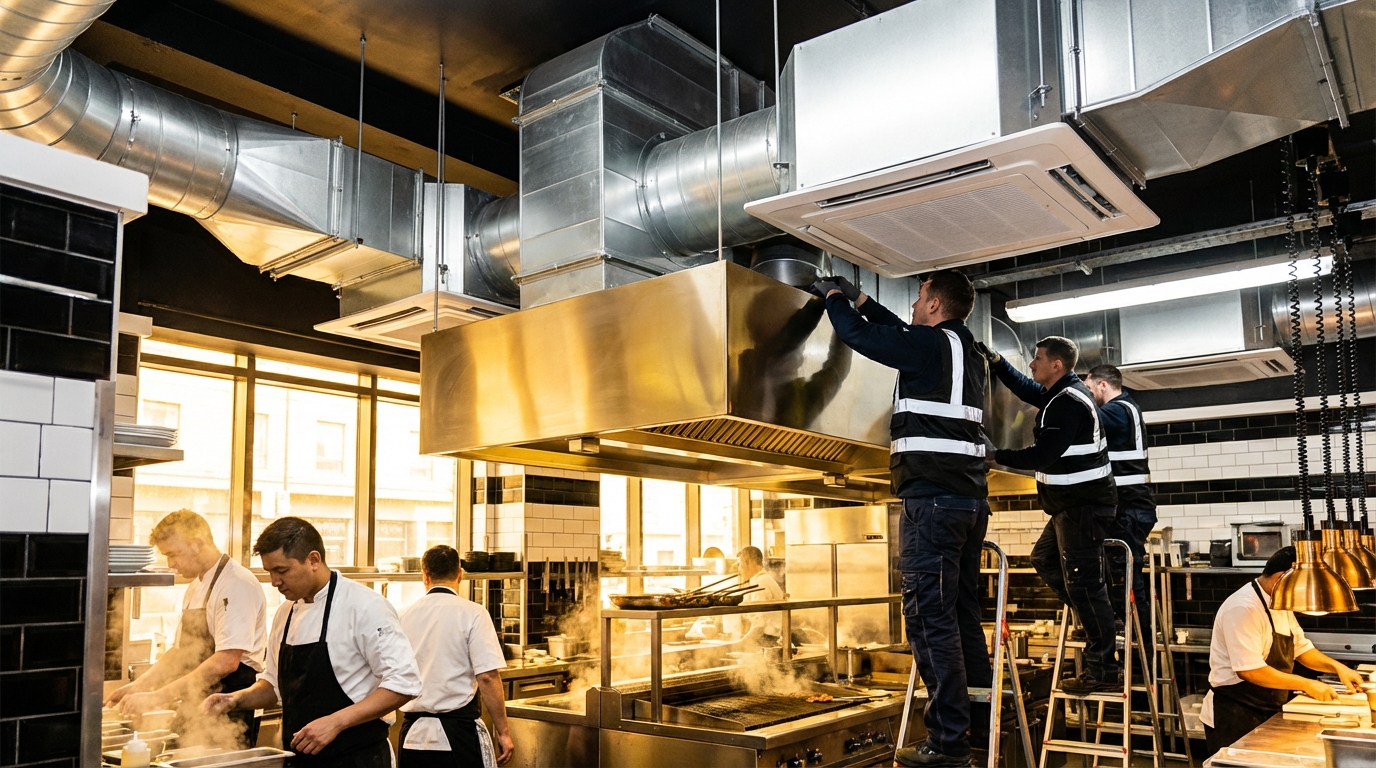
Restaurant kitchens in Wichita stay cool because the HVAC system pulls heat, steam, smoke, and grease-laden air out fast, replaces it with conditioned air, and keeps that process steady during the whole service. When the HVAC installation Wichita is planned around the cooking line, hoods, and local climate, the kitchen stays workable, the food stays safer, and the people on the line can actually think.
That is the short version. The longer story is a bit messier, but more interesting if you care about how a kitchen really feels during a Friday rush.
Why restaurant kitchens overheat so easily
If you spend time on a line, you already know this. Heat is everywhere. But it helps to spell out where it comes from, because HVAC work has to fight all of it at once.
You have:
- Ovens throwing out steady heat, even between orders
- Grills and flat tops running for hours without a break
- Fryers with open vats of hot oil, which also push out moisture and smell
- Dish machines pumping hot, humid air into the room
- Low ceilings or tight spaces that trap heat and steam
- People moving, sweating, and breathing, which adds both heat and moisture
A lot of restaurant owners think, at first, that the answer is “just get a bigger AC unit.” I understand the instinct. You feel heat, so you want more cooling power.
That usually does not fix it. Sometimes it makes things worse, because:
- A too-large unit cycles on and off, so it does not dehumidify well
- Energy bills go up without a clear gain in comfort
- Temperatures swing instead of staying stable
The real fight is not only temperature. It is heat, humidity, smoke, and air movement together. That is where careful HVAC planning comes in.
What a good HVAC setup does for a kitchen line
When an HVAC installer in Wichita approaches a restaurant kitchen, they are usually solving several jobs at once. You can think of it as four main goals.
A well planned HVAC system in a restaurant kitchen does four things at the same time: removes heat, controls humidity, improves air quality, and keeps temperatures steady in every working zone.
1. Pull heat away from the cook line
The first job is basic: get the hot air out of the breathing zone.
This is where hood design and exhaust fans matter. If the hood is the right size, mounted at the right height, and paired with the right exhaust rate, it captures most of the hot air and smoke before they drift into the room.
Once the hot air is removed, the AC does not have to battle the full load. It cools what is left.
If you have ever worked in a kitchen where the hood “breathes” badly and smoke rolls into your face, that is often a sign of poor balance between the exhaust and the supply air. An HVAC installer has to think about both, not just duct some air outside and hope it works.
2. Keep humidity under control
Cooking creates steam. Dishwashers add even more. In Wichita, outdoor humidity in summer can already feel high, so the indoor air can become sticky fast.
Too much moisture in the air can:
- Make the kitchen feel hotter than the thermostat reading
- Lead to slippery floors and extra condensation
- Increase the risk of mold in dark corners and ductwork
An AC system that is sized and set up correctly will pull moisture out of the air instead of just cooling it. Sometimes that means longer, steadier run times at lower fan speed rather than short blasts of very cold air.
I have seen kitchens where the thermostat read 72°F, but everyone felt like it was 80°F because the humidity was high. Proper HVAC work pays attention to that, not only the number on the wall.
3. Protect air quality and food safety
Smoke and grease in the air are a comfort problem, but they are also a food safety and cleanliness problem.
If exhaust and filtering are weak, you can end up with:
- Greasy residue on walls, ceilings, and even plates stored on open shelves
- Lingering smells that mix between the kitchen and dining room
- More frequent deep clean jobs, which cost time and money
Good HVAC design helps air move in a predictable pattern. Fresh air comes in, passes through, and leaves with the heat and cooking byproducts. You want that flow to be steady so that air is not swirling around and dropping grease in random places.
Kitchen comfort is not just about keeping the team happy. Cleaner air and controlled humidity directly support food safety and make routine cleaning faster.
4. Keep different zones workable
A restaurant kitchen is not one uniform space.
You might have:
- A very hot line where grills and fryers live
- A cooler prep area for produce and cold plating
- A dish area that is hot and wet, but often near a back door
If air distribution is lazy, one zone freezes while another bakes. You may have felt this if you have ever seen cooks huddling under a supply vent, while dish staff feel like they are standing in a sauna.
An HVAC installer who knows restaurant layouts will aim supply vents so that cool air does not blast food, but still reaches the people. That sounds obvious, yet it is easy to get wrong.
The Wichita twist: local climate and code rules
HVAC work for a restaurant kitchen in Wichita is not quite the same as in a mild coastal town. The climate and local rules shape the design more than many owners realize.
Hot summers, cold winters
Wichita summers bring high heat and strong sun. Winters can drop below freezing. That means your HVAC system has to switch from full-time cooling to real heating, not just a light bump in temperature.
For a kitchen, the twist is that:
- In summer, the system battles outdoor heat plus kitchen equipment
- In winter, the hood is still dumping heated indoor air outside
So the system must be sized with both seasons in mind. If someone sizes it using only a “standard commercial space” rule, without thinking about all-day grill and fryer loads, the kitchen will suffer in August and maybe in January too.
Fresh air rules and make up air
Local codes, and basic health logic, expect a certain amount of fresh outdoor air to mix into the kitchen.
Every cubic foot of air that goes up the hood has to be replaced. This is called make up air. If you do not bring air back in in a controlled way, the building pulls air in through cracks, open doors, and even from the dining room.
That creates problems like:
- Front doors that are hard to open because of negative pressure
- Smells from the kitchen drifting into the dining area
- Back drafts where air rushes the wrong way through flues
In a hot Wichita summer, a poorly balanced kitchen can feel like a vacuum. If the make up air is unconditioned, it drags in hot, sticky outdoor air that the AC cannot keep up with.
A good HVAC installer in Wichita will usually pair the hood with a make up air unit that can temper the incoming air. Not always fully cool it, but at least keep it from feeling like outdoor July air dumping onto the line.
Energy costs in a real kitchen budget
Restaurants watch food costs. Labor. Rent. Energy tends to sit in the “we pay what we pay” category, until the bill spikes.
Oversized units, old ductwork, and bad balance between exhaust and conditioned supply air all waste energy. In Wichita, where both summer cooling and winter heating can be heavy, that waste adds up.
A bit of planning during HVAC installation can avoid:
- Running air conditioning at full blast while hot air leaks everywhere
- Heating cold outdoor air that did not need to be brought in so aggressively
- Constant cycling that shortens equipment life
I think this is where some owners go wrong. They treat HVAC as a one-time purchase, not as something that affects their monthly bottom line for years.
Key parts of an HVAC system that keep kitchens comfortable
To keep this grounded, it helps to walk through the main parts that play a role in a restaurant kitchen. It is not only the big outdoor unit.
| Component | What it does in a restaurant kitchen |
|---|---|
| Exhaust hood and fan | Captures heat, smoke, steam, and grease right above cooking equipment and sends it outside. |
| Make up air unit | Brings fresh air back into the building so the exhaust fan does not pull the building into negative pressure. |
| Rooftop AC / heating unit | Cools or heats the indoor air, controls humidity, and sends conditioned air into the kitchen and dining room. |
| Ductwork and vents | Distributes air to the right zones and returns it for conditioning again. |
| Controls and thermostats | Manage how the system responds across the day, from prep hours to peak service. |
| Filters and grease traps | Catch particles and grease to protect the HVAC system and keep air cleaner. |
Each part can help or hurt comfort. If the hood is perfect but the make up air is simply a hole that dumps August air on the grill cook, the room will still feel miserable.
How good HVAC installation changes daily kitchen life
If you work in kitchens, the theory is fine, but what you care about is how the room feels at 7 p.m. on a busy night.
Here is how a thoughtful HVAC setup in Wichita can change the daily experience.
Less sweat, clearer heads
In a line that reaches 90°F or more, cooks tire faster. People snap at each other. Mistakes on tickets go up.
When the air movement is tuned and the temps hold closer to the low 70s, even if you still feel warm near the grill, the mental load is lighter. It is easier to focus on plating cleanly and hitting temps.
Better consistency in food
This part might sound small, but it matters.
If the kitchen is extremely hot and humid:
- Proofing dough can go faster than intended
- Chocolate and glazes behave differently
- Cold ingredients warm up faster on the pass
With more stable air, recipes behave closer to how they were tested. You get less guessing and fewer odd surprises.
Less cross talk between dining room and kitchen
When HVAC and airflow are balanced, smells stay mostly where they should.
Patrons smell food, yes, but not a heavy fryer cloud. Staff feel a clear difference when they walk from the dining room into the kitchen, not a wall of smoke.
Also, doors do not slam shut from pressure differences. It sounds like a small detail, but it changes the feel of the space.
Cleaner surfaces with less effort
If exhaust pulls smoke and grease away at the source, you do not see as much sticky film on ceilings, lights, and vents.
That makes daily wipe downs faster and deep cleaning less of a horror show. It also means the HVAC system stays cleaner, which helps it work better over time.
What happens when HVAC is planned badly
Sometimes it is easier to spot what not to do. I have walked through enough cramped kitchens to recognize a few patterns.
Common problems include:
- Exhaust too strong, make up air too weak, creating a vacuum effect
- Supply vents blasting cold air directly on a grill or cutting board
- No separation between kitchen and dining room air patterns
- Units sized by square footage only, ignoring cooking load
- Thermostat in the dining room, far from the kitchen heat
Here is a simple example. The thermostat sits near the host stand in a cooled dining area. The dining room hits 72°F. The kitchen line, closer to the hoods and equipment, sits at 85°F.
The thermostat is happy, so the AC system rests. The cooks are far from happy.
A better plan might use:
- Separate zones for kitchen and dining room
- Thermostat placement where it reflects the real working conditions
- Careful balance between exhaust and conditioned make up air
When HVAC installers treat a restaurant like a generic office, the kitchen pays the price. Kitchens are their own world, with their own heat and airflow problems.
What restaurant owners and managers can ask about HVAC
Even if you never plan to touch ductwork, you can ask better questions. That alone can improve the odds of a good outcome.
1. Where is the heat load coming from?
Ask your HVAC contractor how they are accounting for your specific equipment. Not just “grills” or “fryers,” but how many, what size, and how often they run.
If someone shrugs and says “We go by square footage,” that is a red flag.
2. How are you balancing exhaust and make up air?
You want to hear a clear answer here, something that shows they are thinking about:
- The hood rating and planned exhaust rate
- Where the replacement air enters the kitchen
- Whether that replacement air is heated or cooled at all
If make up air is just raw outdoor air dumped by a vent near the line, summer will feel rough.
3. Can we zone the system for kitchen and dining?
Separate zones give you more control. The kitchen can run a bit cooler while the dining room stays at a comfortable, consistent setting.
This may add some cost, but it pays off in comfort and often in better energy use.
4. How easy is maintenance going to be?
Ask where filters and key components will sit. Can staff or regular service techs reach them without moving half the kitchen?
If filters are hard to reach, they tend to stay dirty longer, and that hurts both air quality and system life.
Simple habits that support a cool kitchen
Even a great HVAC installation can only do so much if daily habits fight against it. The good thing is that some fixes are simple and low cost.
Check and change filters
Grease and dust clog filters faster in a restaurant than in a home. When filters clog, airflow drops. The AC unit strains more.
A basic habit:
- Check filters visually every month
- Replace or clean on a schedule, not just when things look bad
It sounds boring, but it matters more than fancy smart thermostats.
Keep hood and grease filters clean
Grease filters in the hood affect how well the exhaust can pull hot air out.
If they are coated in grease:
- Capture drops
- Airflow slows down
- More heat and smoke drift into the kitchen
Regular cleaning, on a schedule that matches your cooking volume, is not just a fire safety rule. It also supports comfort.
Watch for changes in airflow
If cooks start saying, “It feels hotter than last month,” they might be right.
Common clues:
- Smoke hangs longer above pans than it used to
- A vent that used to blow strongly feels weak
- Condensation on windows or walls appears more often
These are signs worth mentioning to your HVAC service, before something big fails.
Why planning HVAC early in restaurant design matters
If you are still in the design stage of a restaurant in Wichita, HVAC work should not be an afterthought. I know it is not as fun as menu planning or picking finishes, but it affects everything that happens later.
Equipment layout and airflow should talk to each other
The placement of ovens, grills, fryers, and dish machines shapes how air will move. If you decide on a layout without input from HVAC and hood specialists, you can end up:
- Blocking natural airflow with tall equipment
- Placing high heat under a short hood
- Making duct runs much longer and more complex than needed
Sometimes a small shift of a fryer or a range in the drawings can save many headaches later.
Electrical and gas loads tie into HVAC choices
Heavy gas cooking lines throw more direct heat into the room. Electric equipment can behave a bit differently. Either way, the total heat output should sit in the HVAC calculations.
If no one is counting that load, the result is guesswork.
Noise levels in dining rooms
HVAC that works hard for the kitchen still has to stay reasonably quiet for guests.
If duct runs are not laid out carefully, or if returns are too close to seated areas, diners may hear rumbling or whistling. That is hard to fix later compared to planning during design.
Wichita restaurant examples: different needs, same principle
It might help to imagine a few different restaurant types in Wichita and how HVAC plays out for each.
Small fast casual spot near a busy street
Here you may have:
- A compact line with a grill, a small fryer, and a reach-in
- Lots of door openings from takeout and delivery
- Tight seating near the ordering counter
The problem is less about extreme heat from ten burners, and more about:
- Door swings that dump hot or cold outdoor air inside
- Balancing kitchen and customer area in a small footprint
HVAC work might focus on air curtains, smart vent placement, and a right-sized hood. If someone copies a design from a larger restaurant, the small space can feel drafty or stuffy.
Mid size family restaurant with full grill line
Here, the kitchen line might stretch longer, with multiple pieces of gas equipment. You may also have a larger dining room that must stay quiet and comfortable for longer meals.
HVAC choices need to:
- Handle sustained cooking heat over hours
- Keep sound levels down in the dining room
- Allow separate control over bar, dining, and kitchen zones
A careless design can lead to one room always overcooled just so the kitchen can breathe.
High volume kitchen with catering or banquets
This is where heat loads can spike. Large batches, holding cabinets, and dish lines run heavily and sometimes all at once.
Here, the HVAC installation must:
- Prepare for peak loads, not just average lunch service
- Balance back-of-house areas that are not all equally hot
- Work with possibly longer duct runs over a big footprint
The principle is the same in each case. You match the HVAC work to the real kitchen behavior, not a generic template.
How this connects back to people who love food
If you are reading this mainly because you enjoy cooking or eating out, you might wonder why all this talk about ducts and make up air should matter to you.
I would say it matters for three simple reasons.
1. People cook better when they are not fighting heat
Good food depends on focus and timing. A line cook worrying about heat exhaustion has less bandwidth to care about a perfect sear or a clean plate edge.
If HVAC work in Wichita keeps kitchens reasonably cool, the food you get is more likely to be cooked by people who can think clearly, not just survive service.
2. Clean air supports cleaner flavors
Strong odors and grease in the air can linger on clothes, on plates, and in corners. While you might not taste HVAC directly, you feel the difference when a restaurant smells fresh, not heavy and stale.
Behind every calm, pleasant dining room there is usually a back-of-house air system working hard to move heat, steam, and smells in a controlled way.
3. Comfort affects staff retention
Kitchens with better working conditions hang on to staff longer. Faster turnover often hurts consistency and quality.
It is not the only factor, of course, but working every day in a suffocating kitchen wears people down. A system that keeps things cooler is one of the quieter supports for a stable, skilled team.
Some questions people often ask about HVAC and kitchens
Does a restaurant kitchen AC just need to be bigger than normal?
Not always. Bigger is not automatically better. The system needs to be sized for both the cooking load and the space. Oversizing can cause short cycles and poor moisture control. The right size, with proper exhaust and make up air balance, works better than simply picking a larger unit.
Can a restaurant rely on the dining room AC to cool the kitchen?
That usually fails. The kitchen generates more heat and moisture than a typical room. Pulling too much cool air from the dining area can also make guests uncomfortable. Separate or at least carefully balanced zones tend to work better.
Why does the kitchen feel hot even when the thermostat looks fine?
The thermostat might be in the wrong place, like a cooler hallway or dining room. Or the system might not be removing enough humidity. Air at 72°F with high humidity feels warmer than dry air at the same temperature.
Is maintenance really that critical if the system seems to work?
Yes, especially in restaurants. Grease, dust, and constant use age equipment faster. Filters, coils, and fans need regular attention. Waiting until you feel a big comfort problem often means you are already wasting energy or stressing equipment.
Can good HVAC work completely remove the feeling of heat on a busy line?
No, not completely. Standing near grills and fryers will always feel warm. The goal is not to turn the kitchen into an office, but to keep it within a range where people can work steadily without feeling drained or unsafe. A well planned HVAC installation in Wichita will make that difference very clear during your next busy shift.