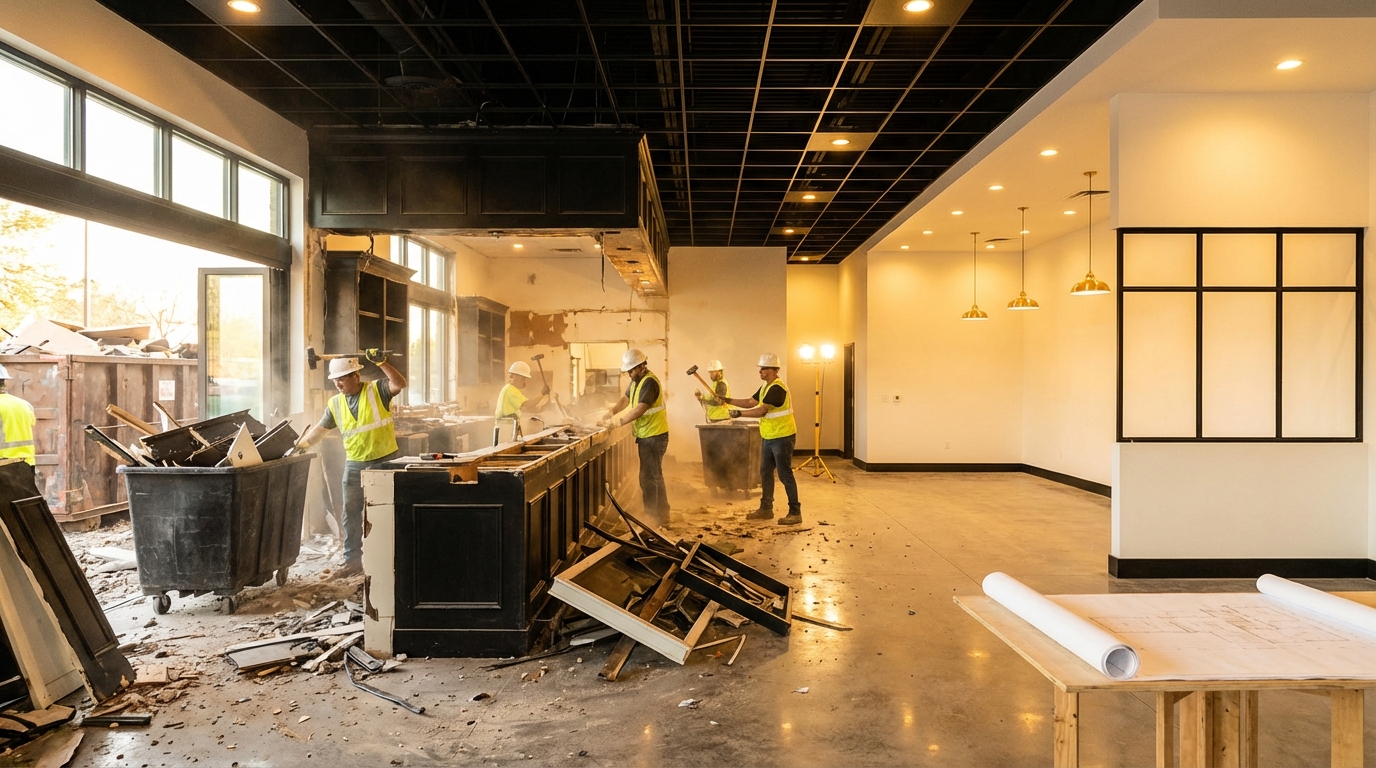
Demolition and hauling reshape restaurant spaces by clearing out what no longer works and making room for a layout that matches how a kitchen and dining room actually function. Without careful demolition and smart hauling, it is very hard to change a cramped, outdated restaurant into a place where food moves smoothly from the line to the table and guests feel comfortable. That is why many owners quietly rely on excavation services long before the first plate of food leaves the kitchen.
Most guests never think about this. They just see the final space. New lighting, fresh paint, maybe an open kitchen. But behind that clean look, there was dust, noise, broken tile, old ductwork, and a lot of debris that had to go somewhere.
If you cook, manage, or dream of opening a restaurant, it helps to understand what actually happens in those messy weeks before the “soft opening.” It is not just smashing walls for fun. There is planning, safety, and a lot of hard choices about what stays and what goes.
Why restaurant projects start with demolition, not design
Many people think the project starts with choosing the chairs or sketching the bar. In practice, it usually starts with asking a simple question.
What parts of this building are holding your restaurant back from working the way you cook?
Demolition is the step that turns that question into physical change. If a hallway blocks the path from kitchen to dining room, it has to go. If the ceiling is too low for proper ventilation, it has to be opened. And old, damaged materials need to be removed before you can safely add anything new.
Without demolition, you are not really redesigning. You are just decorating around old problems.
Function first, then looks
From a cooking point of view, the main goal is simple. Hot food should reach guests at the right temperature without your staff doing a daily relay race. That means the layout has to fit the menu and the style of service.
Demolition helps you fix things like:
- A narrow kitchen that forces cooks to stand shoulder to shoulder
- Walls that break the flow between prep, line, and dish area
- Weird platforms or steps that make moving heavy pans risky
- Old counters built for a different style of service, like a diner or buffet
Maybe you have a strong menu in mind. Wood fired pizza, or a tasting menu, or a casual breakfast place. Each one needs a different shape of kitchen. Removing the wrong walls and surfaces, and keeping the right ones, is how you get there.
Why hauling matters as much as demolition
I think people imagine demolition as the hard part, and hauling as the background task. In practice, they affect each other.
When you tear out tile, drywall, old fryers, tables, and random junk from past tenants, it all has to leave the building. Not next week. Right away, or work slows down and safety risk goes up.
Fast, organized hauling keeps a restaurant project moving, reduces hazards, and gives your team a clear view of what they have to work with.
If debris piles up, workers trip, tools get buried, and everyone gets frustrated. It also becomes harder to notice problems like damaged concrete or hidden leaks, because they are covered in old material.
What gets removed in a typical restaurant gut job
Every site is different, but there are common patterns. A first-time owner is often surprised by how much has to go. Sometimes more than they wanted.
Front of house: clearing old habits
The dining area is usually where people want to spend their budget. New tables, lighting, decor. But demolition here is not just cosmetic. It is about how guests move and how staff reach them.
Common removals include:
- Half walls that block sight lines between servers and tables
- Raised platforms that confuse guests and create trip hazards
- Old booths that eat floor space and limit table layouts
- Bulkheads that make the room feel low and trap grease and dust
- Outdated bar structures that cannot support new equipment
I once sat in a tiny restaurant that had a huge, unused cashier station right in the middle of the floor. The new owner kept it at first because it “felt original.” Guests hated walking around it, and servers squeezed past each other. They removed it months later, which meant more dust, more noise, and lost time. That could have been done in the first demolition round.
Back of house: fixing what the menu cannot solve
In the kitchen and prep areas, demolition usually goes deeper. You are not only thinking about comfort. You are thinking about safety, code, and food quality.
Things that often come out are:
- Old or damaged tile floors with bad slopes and standing water
- Non commercial surfaces that cannot handle constant cleaning
- Walls that trap heat around line cooks
- Drop ceilings hiding grease and poor electrical work
- Small storage rooms that break the flow between walk in, prep, and line
If your menu needs hot line, cold side, pastry, and a dish pit, you cannot just squeeze them into any shape of room. Demolition gives you a blanker canvas so the layout fits the work, instead of the staff bending to fit a bad room.
Hidden elements that change cooking comfort
Some of the most important items to remove are the ones no guest will ever see.
| What gets removed | Why it matters for cooking |
|---|---|
| Old ventilation ducts | Better airflow means less heat on the line and safer removal of smoke and steam. |
| Improper electrical runs | Reliable power for ovens, induction, fridges, and POS reduces shutdowns. |
| Worn insulation | Helps control heat between kitchen and dining, and can lower noise transfer. |
| Outdated plumbing routes | Correct sink and drain positions support cleaning and food safety. |
No guest will ever praise your upgraded drains. But they will notice if plates are delayed because the dish area is always backed up due to a cramped layout dictated by old plumbing.
How demolition choices affect the guest experience
It might sound strange, but the way you tear things out shapes the way people eat and relax in your restaurant.
Noise, comfort, and the choice to keep or remove walls
Open kitchens look appealing. You see the energy, the flame, the plates going out. But there is a tradeoff. Once you remove a wall, sound and smell move freely into the dining room.
A thoughtful demolition plan weighs the thrill of an open view of the kitchen against noise levels, cooking smells, and guest comfort.
Some owners pull down every divider, then later realize the dining room is loud and hard to manage. Others keep too many barriers and end up with servers bumping into corners to reach tables.
I think the best plans usually sit somewhere between. Maybe you remove a full wall and rebuild a half height partition near the pass. Or you keep a glass divider that lets guests see but not hear everything.
Flow for staff and guests
Hauling plays a quiet role here too. Once you remove old structures, you get a better sense of real space. Walking the empty shell with tape on the floor can help you model how servers and guests will move.
Questions to ask during this stage:
- Can a server carry two hot plates from the kitchen to the farthest table without turning sideways?
- Does anyone have to cross paths with a busser carrying trays of dirty dishes?
- Is there a clear line between waiting guests and working staff near the entrance?
- Where will guests naturally pause or cluster, and do those areas need more space?
Those decisions often mean more selective demolition. You might remove part of a wall near the host stand, or take out an odd storage closet that blocks the path from the bar to the patio.
Light and smell
Removing old ceilings or storage areas can change how natural light enters the space. For a brunch spot, that can be a big gain. For a fine dining room that depends on mood lighting, it might be less helpful.
Removing partitions around the kitchen or bar also lets cooking smells travel. Some owners love that. Fresh bread or grilled meat can draw people in. Others worry about guests leaving with their clothes smelling like fry oil.
Demolition sets the stage for that balance. Once a wall is gone, it is not always simple to add it back, at least not without cost and more disruption.
Safety, codes, and the less glamorous side of demolition
For people used to recipes and plating, the world of building code and permits can feel heavy and slow. But if this part is rushed, you pay for it later. Sometimes literally, with fines or shutdowns.
Load bearing walls and structure
You cannot just knock out any wall you dislike. Some walls carry the weight of the floors above. Removing them wrong can damage the building or create serious risk.
A good demolition plan checks:
- Which walls are structural
- Where new beams or supports are needed
- How added weight from new equipment affects floors
For example, installing a large pizza oven or smoker in a second floor space might require reinforcement. That often means cutting and rebuilding parts of the floor. Without proper hauling, those heavy chunks of old concrete or steel become a hazard very quickly.
Hazardous materials
Older buildings often hide things like asbestos, old lead paint, or aging electrical systems. These are not fun topics, but they matter for health and legal reasons.
Safe demolition involves:
- Testing suspect materials before tearing into them
- Using protective methods and gear when needed
- Hauling and disposing of hazardous debris according to local regulations
Skipping this can delay your opening far more than careful planning would have. Reality is, you cannot talk your way out of a safety violation once it is found.
Fire safety and exits
When you remove or add walls, you impact escape routes and fire safety. This is not just a code checklist. It is directly tied to the way guests and staff could leave during an emergency.
Some choices that seem small, like narrowing a hallway to add a few more seats, may conflict with rules about exit width. Reversing that after construction can be expensive. It is better to think about it while you still have an open shell and a pile of debris waiting for hauling.
How demolition supports different restaurant concepts
Not every restaurant needs the same level of demolition. A coffee shop does not have the same needs as a raw bar or a steakhouse. I think it helps to look at a few broad categories and how demolition and hauling change the space.
Fast casual or counter service
These spaces often live in older retail units. They might be converting a clothing store or an office.
Common changes:
- Removing old partitions to make one open prep and service area
- Pulling out carpet and installing cleanable flooring
- Opening walls to bring plumbing and electrical to the counter line
- Adding or widening access to the back for deliveries
Hauling here tends to be about volume. Shelving, partitions, ceiling grid, flooring. It is often a full strip down to the slab and bare walls before the build back starts.
Full service dining
A sit down restaurant needs more controlled zones. A clear bar area, a calm dining space, and a kitchen that can handle longer cook times.
Demolition might target:
- Old bar backs that cannot support new refrigeration or taps
- Walls that block views for servers scanning the room
- Cramped dish areas that create traffic jams near the kitchen door
- Old bathrooms that do not meet current accessibility standards
The volume of debris here can be heavy. Stone bar tops, backed tile, large coolers. Careful hauling keeps the floor clear for trades to move in and start new work quickly.
High heat concepts: pizzerias, grills, and bakeries
These kitchens need to deal with serious heat and heavy equipment. Often, demolition is deeper.
You might see:
- Ceilings removed to run new exhaust and make room for hoods
- Floors opened to add or move gas lines
- Portions of exterior walls opened for vents or make up air
- Portions of slab cut and hauled away to provide drains in the right spots
In these projects, the right demolition and hauling decisions affect cook comfort and food quality. Bad venting means inconsistent oven temperatures and grumpy line cooks. Good venting starts by clearing out what was there before.
Why timing of demolition and hauling matters
Restaurant projects are often on tight budgets and tighter schedules. Every week you are closed, you are paying rent without bringing money in. So it is tempting to rush demolition or mix it with other work.
That usually does not work well in practice.
Staging the chaos
A more realistic approach is to stage demolition in clear phases:
- Strip out fixtures, furniture, and easy items
- Open selected walls and ceilings to expose structure and services
- Pause to inspect and adjust the plan based on what you find
- Remove remaining surfaces and structural elements as needed
Hauling should track each stage. If demolition gets too far ahead of hauling, the site becomes hard to work in. If hauling comes too early, you pay for extra trips.
There is a bit of art in matching those rhythms. Good crews learn how to keep the space just messy enough that progress is real, but not so messy that it feels like a junkyard.
Dealing with surprises
Anyone who has opened a restaurant in an older building can list surprises they found behind walls. Old brick, odd wiring, random pipes, strange platforms. Some are nice. Exposed brick can become part of the design. Others are not so nice.
When demolition exposes something unexpected, you often face a choice:
- Remove it and haul it out, accepting extra cost and time
- Work around it and adjust the layout
- Keep part of it as a feature, but reinforce or clean it
Not every surprise is worth saving. I have seen owners cling to awkward original features that make staff life harder, just because they felt “authentic.” That kind of nostalgia can slow service and hurt the guest experience.
Waste, recycling, and what happens to the old restaurant
One thing people rarely ask is what happens to the debris. Tables, broken tile, rusted sinks, old metal ductwork. They do not just vanish.
Sorting and recycling
Many demolition and hauling crews sort as they go. Metal, clean wood, concrete, and other materials can often be recycled or sent to different facilities. This is not always perfect, and it varies by region, but careful sorting can:
- Lower disposal costs
- Reduce the volume going to landfill
- Speed up unloading at disposal sites
From a restaurant owner’s view, you might not see this directly. But it can show up in the final bill and in how fast crews can come back for another load.
Reusing elements inside the new space
Sometimes parts of the old restaurant get a second life. That seems to be more common now. Someone keeps the original brick, reuses old wood as shelving, or turns a long table into a host stand.
That said, not everything should be saved. There is a line between smart reuse and clutter. Old booths with deep cracks, greasy surfaces that never fully clean, broken tiles that will fail again. Those usually belong in the dumpster, not the dining room.
If you like the idea of reuse, it often helps to tag items before demolition starts:
- Mark “save” on pieces you might want later
- Photograph locations before removal
- Store saved items away from the active demo zone
This sounds simple, but in the rush of a job, unmarked items can quickly end up in the haul away pile.
Planning your own restaurant demolition: practical questions
If you own or plan to open a restaurant, you do not need to become an expert in demolition. But you do need to ask clear questions and push back when something feels off. Blind trust is not a strategy.
Questions to ask before anything gets torn out
- What parts of the space must stay for structural or code reasons?
- Which walls, floors, or ceilings are optional to remove, and why?
- How will demolition affect neighbors in the building or nearby tenants?
- How many days are planned for demolition and hauling, and what could extend that?
- What is the plan for dealing with unexpected issues inside walls or ceilings?
If you get vague or overly confident answers, that might be a sign to slow down and ask for more detail.
Balancing budget with real needs
I disagree with the idea that you should always “gut it to the studs.” Sometimes that is wasteful. If a section of tile, for example, is in good shape and in a low stress area, you might keep it and spend money elsewhere.
Still, trying to save too much can backfire. Keeping a bad kitchen layout to spare a wall might cost you far more in long term staff turnover and slow service.
The real goal is not minimum demolition, but the right demolition that gives your concept room to work for years.
Ask yourself which parts of the space directly affect food quality, speed, and guest comfort. Those areas deserve priority when deciding what to remove or rebuild.
How demolition and hauling shape daily life in the finished restaurant
After opening, you probably will not think about the weeks of noise and dust very much. But the choices made during that time show up every single shift.
Lines that feel calm, even when you are in the weeds
A kitchen that went through smart demolition often has:
- Clear stations with enough elbow room
- Logical routes between prep, line, and dish
- Storage near where ingredients are actually used
- Airflow that keeps cooks from baking under the hoods
Staff might not praise the old demolition crew by name, but they feel the difference. Tickets come in, plates go out, and the space supports that rhythm instead of fighting it.
Dining rooms that feel natural to move through
When walls and old dividers come out in the right places, guests do not get stuck in tight corners. Servers can see who needs a refill. Host staff can sense the room without orbiting the whole floor.
A good layout, shaped by smart demolition, allows you to adjust. Tables can shift slightly for a large party. Chairs can move to open a path for a wheelchair. These small flex points add up to a calmer experience for everyone.
Noise and privacy balance
There is no perfect answer here. Some people love a loud, busy dining room. Others want soft conversation. Demolition gives you a chance to choose, but you cannot please every taste at once.
Removing too much tends to lead to echo and constant chatter. Keeping too much leads to dead corners and sight line problems. That middle ground often comes from partial demolition and rebuild, not an all or nothing approach.
Common mistakes owners make around demolition
I think it helps to be honest about missteps people make, especially first timers. It is not about blame, just learning from patterns.
Falling in love with the wrong existing features
Old brick can be charming. Strange platforms, odd closets, or awkward arches usually are not, at least not for staff.
Holding on to difficult elements purely for character often leads to:
- Trip hazards for servers
- Wasted space that could hold more tables or storage
- Annoying routes for food runners and bussers
If a feature does not serve the way your restaurant will operate, think twice before telling the demolition crew to “work around it.” That can cost more than removing it properly.
Underestimating debris volume
Owners often picture a few dumpsters. Then the first day of demolition fills them. Old tile, plaster, metal, and broken equipment take up more room than most people expect.
When hauling is under planned, you see:
- Overflowing dumpsters blocking access
- Crews waiting for new containers instead of working
- Neighbors complaining about mess or noise extensions
A better approach is to plan for more hauling capacity than you think you need, then adjust down if the volume is smaller.
Ignoring staff input
The people who will cook and serve in the space every day often have useful ideas about what should be removed.
They might say:
- “This corner will always bottleneck during service.”
- “This closet is too far from the bar to be useful.”
- “If we keep that raised area, someone will fall carrying plates.”
While you cannot follow every suggestion, bringing a chef or manager into the shell at the demolition stage can prevent layout problems that look fine on paper but fail in real life.
Questions and answers to think through
Q: Do I really need heavy demolition if the previous restaurant was already working?
A: Not always. If the prior layout supports your menu and service style, you may keep more than you expect. But “working” for them does not mean ideal for you. If your menu, volume, or style is different, partial demolition is often smart. Look at whether the existing kitchen flow, storage, and dining room sight lines match how you plan to run service. If they do not, saving everything just because it seems easier may limit you for years.
Q: How early should I involve demolition and hauling in my planning?
A: Earlier than most people think. Too many owners finish their design drawings, then call a demolition crew and hear that parts of the plan are awkward or expensive to execute. If you involve demolition and hauling teams while you are still shaping the layout, they can flag structural limits, debris issues, and access problems before they become big costs. That does not mean they design the restaurant for you, but they can ground your plans in what the building can realistically handle.
Q: What one thing from demolition has the biggest impact on my day to day cooking life?
A: If I had to pick just one, I would say the path from prep and storage to the line. Demolition that clears a straight, wide, unobstructed route between those areas affects every single shift. It shapes how quickly ingredients move, how safe staff feel when carrying hot or heavy items, and how easy it is to adjust when the menu changes. It is not the most glamorous part of the project, but it might be the one you silently appreciate every time service gets busy.