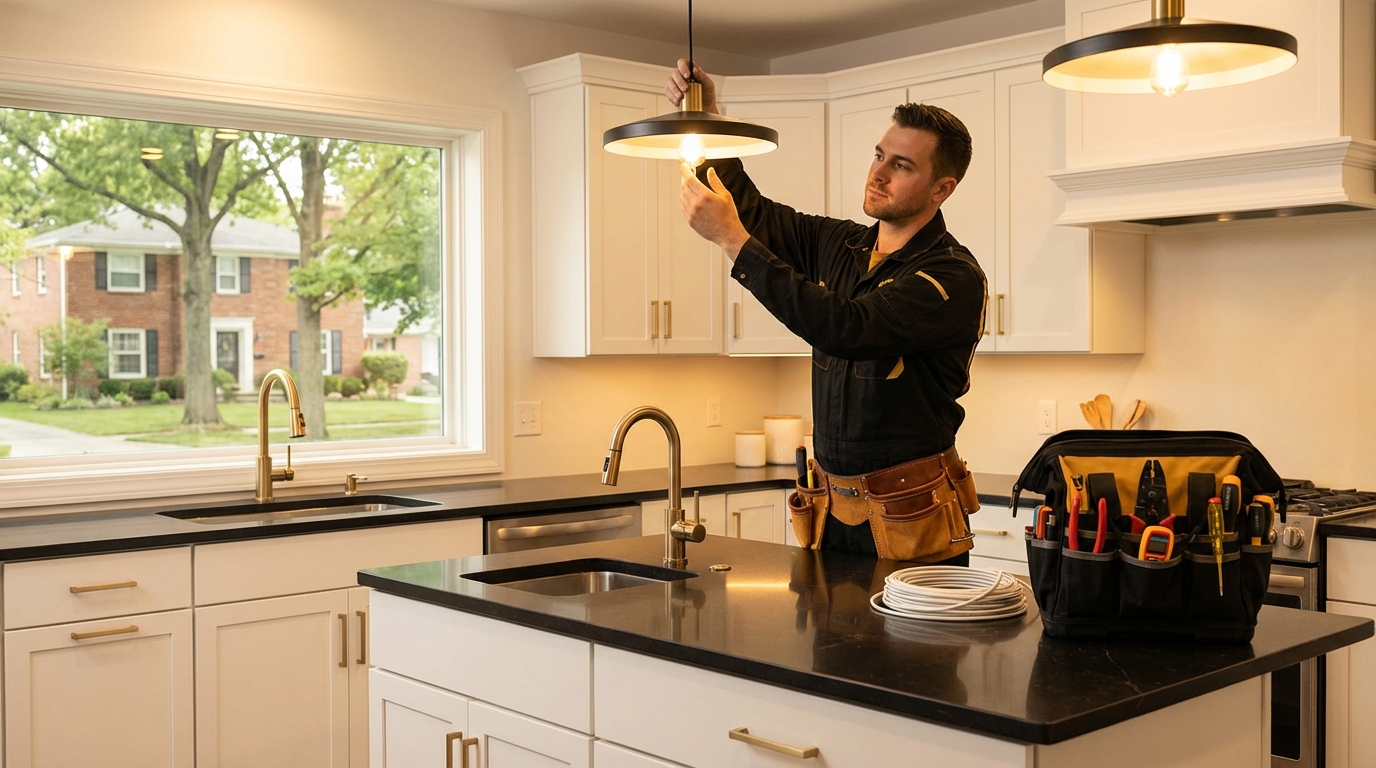
Your kitchen runs on electricity every single time you cook, and a residential electrician Indianapolis is the person who makes that possible in a safe, organized way. They design the circuits that feed your stove and oven, size the wiring for your fridge and dishwasher, plan where outlets go on the backsplash, and set up lighting so you can actually see what you are chopping. Without that planning and the behind-the-scenes wiring, your kitchen would trip breakers all the time, overheat, or in the worst case, create fire risks.
I think many people see the shiny gas range or the expensive espresso machine and forget that every one of those things has an electrical story behind it. If you love to cook, or you run a small home-based food project, what your electrician does in your walls is as real a part of your kitchen as your knives and pans.
How power really moves through your kitchen
Let us start with what actually happens when you turn on your oven or blender. It feels simple: flip a switch, press a button, hear a click. The route behind that is not so simple, but it can be explained in a pretty straightforward way.
Power comes from the utility into your main service panel. From there, your electrician divides it into separate circuits. Each circuit is a path of wires that serve a group of outlets, lights, or a single large appliance. In a kitchen, that layout matters a lot because you usually run many things at once.
I once watched an electrician redraw a kitchen plan where the designer had put every counter outlet on the same circuit. It would have worked on paper. In real life, the first time someone tried to run a microwave, toaster, and stand mixer together, the breaker would have tripped. He split the loads across several circuits instead, and the cook in that house never had to think about it.
The way your kitchen is wired decides whether you can cook freely or keep stopping to reset breakers.
Here is a simple breakdown of how the power in a kitchen usually gets organized.
| Kitchen area / equipment | Typical electrical setup | What the electrician worries about |
|---|---|---|
| Countertop outlets | Multiple 20-amp small appliance circuits | How many appliances you might run at once |
| Range / cooktop | Dedicated 240V circuit, higher amperage | Correct wire gauge, breaker size, and location |
| Oven (if separate) | Dedicated 240V or 120V circuit, depending on model | Load calculation and manufacturer requirements |
| Refrigerator | Usually dedicated 15 or 20-amp circuit | Keeping it on during outages with backup plans |
| Dishwasher & disposal | Often separate circuits, sometimes shared as allowed by code | Start-up current, moisture protection, disconnects |
| Lighting | 1 or more 15-amp lighting circuits | Switch locations, brightness, future fixtures |
If you cook often, or you host big dinners, this layout matters more than you think. It is the difference between calmly finishing a sauce and running to the panel when the breaker trips as soon as your guest plugs in a coffee grinder.
The invisible side of kitchen safety
For people interested in food, it is natural to focus on sharp knives and hot oil when you think about safety. Electricity does not look scary. The light just comes on. That is the odd part. Electrical risks often stay hidden until something has gone very wrong.
A local residential electrician spends much of their time preventing trouble you never see. That work shows up in three main areas in a kitchen: shock protection, fire prevention, and smart circuit planning.
Shock protection near water and metal
Your kitchen has water, metal sinks, and grounded appliances all close together. That mix can be risky if the wiring is old or done poorly.
Modern kitchens use GFCI protection for outlets near sinks and other wet areas. GFCI stands for Ground Fault Circuit Interrupter. You have probably seen them, the outlets with “test” and “reset” buttons.
If you are standing barefoot at a sink and something goes wrong in a plugged-in appliance, the GFCI is the device that is meant to cut power fast enough to save your life.
An electrician does a few things with GFCI protection:
- Places them in all required areas near sinks or water
- Chooses between GFCI breakers and GFCI receptacles
- Tests them after installation and, ideally, during later service calls
Many older houses in Indianapolis still have kitchens without proper GFCI coverage. Some have outlets that were just “swapped out” by a handy friend. The buttons are there, but the line and load are mixed up, or the ground is not correct. A licensed electrician actually tests the circuit with tools, not just by pressing the buttons.
Reducing fire risks behind your walls
Another quiet job is protecting your kitchen from overheating wires and loose connections. Cooking spaces run heavy electrical loads, often for long sessions. Ovens preheat. Slow cookers sit on all day. A double-basket air fryer pulls quite a bit of current.
Electricians pay attention to things that most of us do not want to think about, like:
- Whether the wires are thick enough for the breaker size
- How many splices and junction boxes sit in a hidden cavity
- Whether any connections feel warm under load
- Whether aluminum branch wiring is present and needs work
An overloaded or loose connection might work fine for months, until the day it gets just hot enough to start something smoldering in a wall.
I once talked with a homeowner who kept smelling something faintly “hot” near the pantry when the oven was on. They had written it off as just food smells. An electrician later found a loose connection in a box feeding the oven circuit. The insulation had begun to darken. That is the sort of near-miss that rarely makes it into a story, but it is not rare at all.
Why kitchens get special electrical treatment
Kitchens fall into a special category in building codes. There is a reason. They pull more power in a small area than almost any other room in the house except maybe a workshop or a home theater, and those usually do not involve water and metal sinks.
If you compare a bedroom and a kitchen in electrical terms, the difference is large.
| Room | Common loads | Typical concerns |
|---|---|---|
| Bedroom | Lamp, phone charger, maybe a TV | Comfort, convenience, a few outlets |
| Kitchen | Oven, microwave, toaster, mixer, fridge, dishwasher, lights, gadgets | Load balancing, moisture, higher heat, more circuits |
A residential electrician in Indianapolis has to size the kitchen with this in mind, or cooking becomes a small battle with your own electrical system.
Dedicated circuits for hungry appliances
Most serious cooking gear wants its own circuit. That is not a sales pitch from electricians. It is about how much power those devices pull, especially when they start up.
- Electric ranges and ovens: often require a 240V dedicated circuit
- Microwaves: many built-ins and large countertop units are on their own circuit
- Dishwasher: typically needs a separate line
- Garbage disposal: often has its own breaker or a carefully planned shared circuit
- Refrigerator: often dedicated, to avoid nuisance trips
If you cook a lot, or if you plan on adding heavier equipment later, it helps to say that early. Many electricians appreciate when a homeowner says something like, “I run two crockpots, a sous vide, and a rice cooker at the same time on Sundays.” That is more helpful than “we cook a lot,” which can mean many things.
Enough outlets where you actually cook
There is a big difference between a kitchen that looks good on a plan and one that works. People who cook seriously often find they do not have enough outlets exactly where they prep. Cords drape across sinks. Extension cords sneak in, which is not ideal in a wet area.
Electricians will usually follow code spacing, but a good one also asks how you move around your kitchen. For example:
- Where do you usually chop vegetables
- Do you keep the coffee machine out all the time
- Do you bake often and run a stand mixer
- Do you use portable induction burners for extra pans
Sometimes a small change in outlet placement makes more difference than an expensive appliance. I remember seeing a kitchen with a long island that had only one outlet at one end. It looked clean, until the first holiday dinner. Suddenly everyone was crowding one small corner with slow cookers, creating a tangle of cords. An extra pair of outlets in the middle would have changed the whole feel of that day.
Lighting that actually supports cooking
Good lighting in a kitchen is not just about style. It affects how safely you can work and how you feel standing at the counter for an hour or more. Electricians are the ones who actually run the cable and connect the switches, so they end up shaping the way your kitchen looks and feels every evening.
Layers of light for real cooking, not just photos
Most kitchens work better with three types of light:
- General lighting from the ceiling, like recessed cans or a central fixture
- Task lighting under cabinets, over the sink, and at the range
- Accent or “mood” lighting, such as above-cabinet strips or pendants over an island
An electrician has to decide things like:
- Which lights go on which switch
- Where dimmers make sense
- How to route wires so future changes are possible
When you cook, task lighting might matter more than the pretty pendant. If the cutting board is in your own shadow because the only light is behind you, the room can be bright and still not feel right.
If you have ever squinted at a piece of chicken to see if it is cooked through, what you really wanted in that moment was better task lighting.
Electricians can fix this with simple choices:
- Under-cabinet strips to light the counter directly
- A dedicated light for the sink area
- Better placement of recessed cans so they sit in front of you, not behind you
Planning a remodel for real cooking, not just resale
If you are thinking about a kitchen remodel, you might be looking at cabinet styles and countertop materials. That is normal. But if you care about cooking, starting a conversation with the electrician earlier than you think can pay off.
Many remodels treat electrical work as something that gets figured out “later.” I think that is backward, at least for a kitchen. Electrical planning shapes how you actually cook in the space.
Questions to ask your electrician before walls close
You do not need to learn all the code rules. It does help to ask practical questions about how your kitchen will feel day to day. For example:
- How many small appliance circuits are you planning for my counters
- Where will the switches be when I walk in from the garage with groceries
- Can we add more outlets on the island for holiday cooking days
- If I add a second wall oven later, will the panel handle it
- Can any circuits be set up with a view to a future backup power system
Electricians often have strong opinions about what works well in a kitchen, based on seeing what has failed in other homes. Sometimes they are more realistic than the glossy design photos. They will think about your panel capacity and layout in a way that most cabinet designers just do not.
How small electrical choices affect cooking every day
Some decisions in a kitchen feel small while you are planning. They show their impact later, when you are actually cooking. I have seen people regret skipping certain things they once called “extras.”
Extra outlets for flexible cooking
If you cook multiple-course meals, run a home baking side gig, or just like to experiment with new gadgets, outlet count and placement can change how you use your kitchen.
Here are a few places where extra outlets help more than people expect:
- Inside a pantry for a bread maker or small freezer
- In the back of cabinets for a built-in microwave or coffee station
- Low on the side of an island for slow cookers or buffet warming trays
- Above or near a bay window where someone might sit with a laptop while sourdough proofs
This is where a bit of honest self-awareness helps. If you never host, you may not need island outlets for six crockpots. If you host large family meals every year, wiring to support long buffets can be worth more to you than a fancy faucet.
Choosing between gas and electric with wiring in mind
People in cooking circles can be very firm in their opinions about gas versus electric ranges. The electrician quietly stands behind those choices with actual wires and circuits. Switching fuels is sometimes easy, sometimes not.
| Range type | What the electrician checks | Common surprises |
|---|---|---|
| Gas with electric ignition | Standard 120V outlet, location, grounding | Outlet hidden behind range, sometimes not GFCI protected in older homes |
| Standard electric range | 240V dedicated circuit, correct breaker and wire size | Panel may not have enough capacity for upgrade from gas |
| Induction range | Often higher amperage needs, careful circuit sizing | Existing wiring sometimes too small, requires new line |
If you think you might move to induction later, asking your electrician to size the circuit for that future switch can save you from opening walls again. That is not true in every case, but it is worth asking instead of assuming.
When your kitchen hints that it needs an electrician
Kitchens often give little signs that the electrical system is not keeping up. These signs can feel like small annoyances at first. Over time they can become safety issues or just constant frustration while cooking.
Common warning signs while you cook
- Lights dim slightly when you start the microwave or mixer
- Breakers trip when you use more than one heavy appliance at once
- Outlets feel warm to the touch after use
- You rely on extension cords around the sink or stove
- Older two-prong outlets still exist in the kitchen
- Under-cabinet lights flicker when other appliances run
If your routine cooking regularly trips breakers, your home is telling you that the electrical plan and your actual cooking style do not match.
Some of these are simple fixes. Others might suggest the need for panel work or reconfiguring circuits. Either way, ignoring them rarely makes cooking more pleasant.
Smart kitchens, but grounded in reality
More people are adding smart devices to their kitchens: connected ovens, app-controlled lights, Wi-Fi plugs for slow cookers, and so on. It can be fun, and sometimes it is genuinely useful. Preheating an oven from the car is not the worst idea on a busy weeknight.
Still, every smart feature rides on top of basic electrical work. A smart switch that randomly cuts out because the neutral is shared badly, or because the connection is loose, is just a headache. Before stacking more electronics onto your kitchen, it makes sense to check that the base wiring is solid and the panel is not already close to full capacity.
In some homes, the smartest upgrade is something plain like:
- Dedicated circuits for heavy appliances
- Upgraded lighting with good color temperature for cooking
- Better outlet placement for everyday tools
That does not look as flashy as a screen on the fridge, but in daily use, it often matters more.
How to talk with an electrician if you care about cooking
If you love food and you spend a lot of time in your kitchen, you have a certain way of moving, prepping, and cleaning that is different from someone who just reheats takeout. An electrician does not know that unless you say something.
Instead of just pointing at a floor plan, you can describe real situations:
- “On holidays, we run three slow cookers all day plus the oven.”
- “We do weekly meal prep with a blender, food processor, and rice cooker going together.”
- “We bake bread twice a week and need bright light on this side of the counter.”
- “We host friends at the island, and they bring laptops and phone chargers.”
Those details give your electrician something practical to design around. They might suggest extra outlets, more circuits, or a slightly different light plan. You do not have to accept every suggestion, but at least you are making choices based on how you really cook, not just how the kitchen looks on a mood board.
Quick Q&A: Common kitchen electrical questions from home cooks
Q: Why does my breaker trip when I run the toaster and microwave together?
A: They are likely on the same small appliance circuit, and their combined draw is higher than the breaker rating. An electrician can split those outlets onto different circuits or add another circuit so you can use both without tripping the breaker.
Q: Do I really need GFCI outlets near my kitchen sink?
A: Yes. They are there to protect you when water and electricity might mix. If your kitchen does not have them near sinks or other wet areas, an electrician should update that part of the wiring.
Q: Is it worth upgrading my kitchen lighting if it “already works”?
A: If you find yourself squinting, moving cutting boards to brighter spots, or getting eye strain while cooking, better lighting is worth it. Under-cabinet lights and improved overhead placement can change how you feel while prepping food.
Q: Can my panel handle a new induction range?
A: That depends on your existing service size, panel space, and what is already connected. An electrician will look at your current loads, the range specs, and your panel to see if you need a new circuit only or a larger upgrade.
Q: How many outlets should I have on my kitchen counters?
A: Code sets a minimum spacing, but cooks often prefer more than the minimum. If you regularly use three or more plug-in appliances at once, more circuits and outlets spread along the counter can make life easier.
Q: If I could change only one electrical thing in my kitchen, what should I start with?
A: That depends on your space, but many serious home cooks get the most day-to-day value from better lighting and more thoughtfully placed outlets on separate circuits. It is not glamorous, but it affects every single meal you prepare.