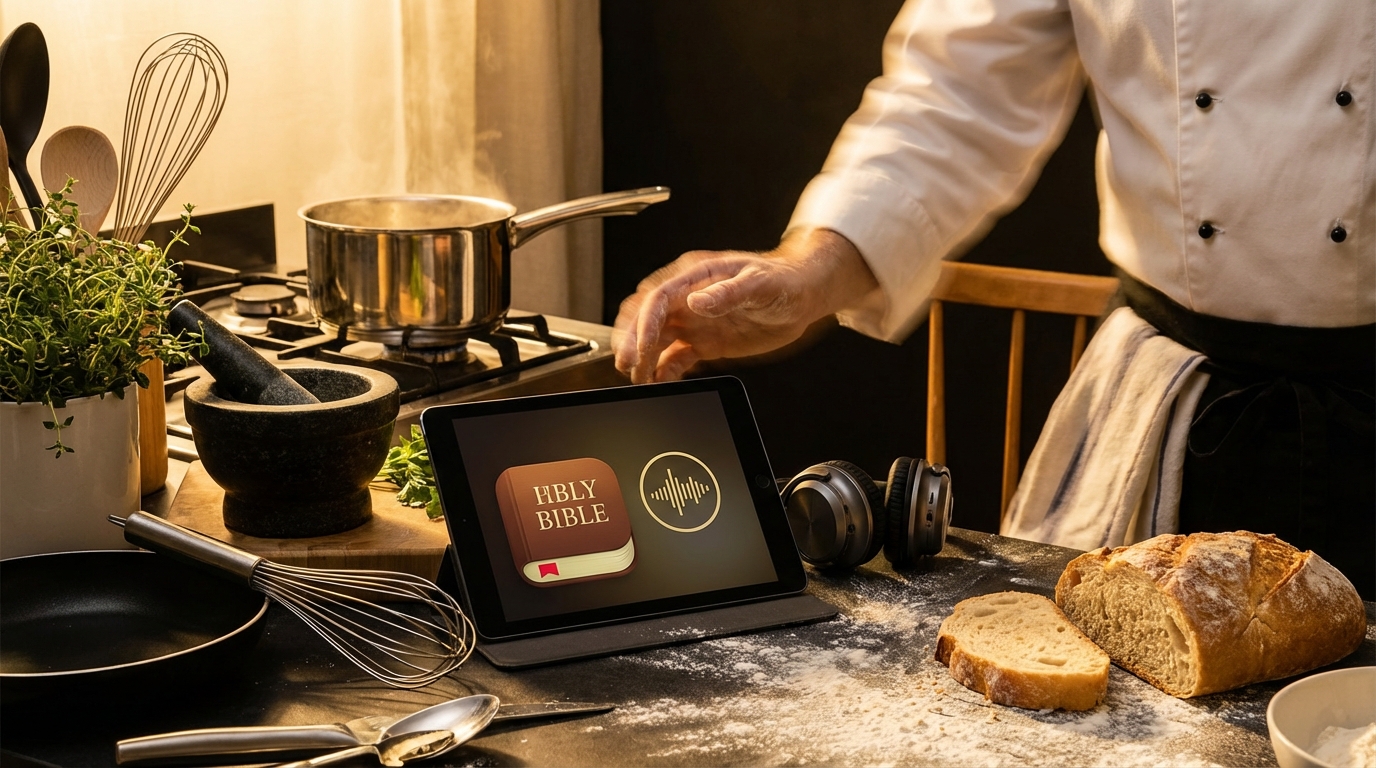
If you are a chef or a food lover who spends most of the day around heat, knives, and chaos, a Digital Bible with audio lets you listen to Scripture while your hands stay busy. You can have full chapters playing over your kitchen speaker, follow verse-by-verse explanations on your phone during prep breaks, and even replay key passages while you commute to and from the restaurant.
That is the simple idea. You do not need extra time. You do not need a quiet study corner, at least not all the time. You use the minutes you already have, the ones that usually disappear into background noise. And you let those minutes fill with something calmer and deeper than another random playlist.
Why an audio Bible actually fits kitchen life
If you work in food, your routine is probably not gentle.
You are tasting sauces, checking tickets, plating, wiping, rushing. Or, if you are more on the home cook or foodie side, you might be juggling groceries, recipes, and family at the same time.
Reading a printed Bible in the middle of that is hard. Your hands are wet or oily. There is steam everywhere. You get interrupted every 30 seconds.
Listening is different.
You can chop onions and still follow a story. You can hear the Sermon on the Mount while washing dishes. You can run a batch of dough through the mixer and keep track of a psalm.
For busy cooks, audio is not a luxury feature. It is often the only way Scripture fits into the real rhythm of the day.
You might think, “But if I only listen, will I really understand anything?” That is fair. Some people worry that hearing the Bible in the background will feel shallow.
The helpful part is when audio comes with structure: clear chapter labels, verse references, and short explanations that you can pause and come back to. You are not just letting words wash over you. You are slowly building familiarity, like you built your knife skills over thousands of small cuts.
How a digital Bible can live in your kitchen
If you treat the digital Bible like an app that belongs in your kitchen tool kit, it starts to feel less strange. You already trust timers on your phone, temperature probes, recipe apps, POS screens, ordering systems.
Scripture can sit beside those.
Here are a few simple ways to make it part of your cooking life:
1. Set a “prep playlist” that is Scripture, not just music
You likely have set playlists for prep, service, or cleanup.
You can pick one short window, maybe 20 or 30 minutes a day, where audio Bible takes that slot. It could be:
- Early morning prep before the rest of the team arrives
- Mid-afternoon lull between lunch and dinner service
- Cleanup after close, when everything is calmer
You do not need to turn the kitchen into a quiet chapel. You just choose one slice of time where Scripture is the thing playing. Over months, that builds up surprisingly fast.
2. Use chapter breaks like recipe steps
Long text can feel heavy, but audio chapters are broken by design. Each one has a clear start and finish.
Think of them like recipe steps:
- One chapter while you prep a tray of vegetables
- One chapter while bread is in the oven
- One chapter while you clean the grill
This is not mystical. It is just a rhythm. Many cooks already think in blocks of time. You know your risotto takes one song. Your roast takes three tracks. Now it might be one or two Bible chapters.
3. Treat verse explanations like recipe notes
Most serious cooks like recipes that include notes: why a certain rest is needed, what the texture should feel like, what can go wrong. Plain lists of ingredients feel empty without that background.
A good digital Bible with commentary works the same way.
You hear a verse, then you have access to:
- Historical background, like who was speaking and to whom
- Word meanings that do not come across in translation
- Plain explanations of hard phrases
- Short thoughts on how this might relate to real choices today
If you are willing to read recipe footnotes, you already understand how verse-by-verse explanations help. They are not there to sound academic. They are there so the whole thing makes more sense.
You might listen first, then later, during a break or at home, you scroll back and read the notes for the parts that stuck with you.
Bible listening ideas for different food people
Cooks and food lovers are not all the same. Some live on the line. Some are food bloggers. Some care more about eating than cooking. Scripture listening can match those patterns pretty well.
For professional chefs and line cooks
Your time is chopped into strange shapes. Long stretches of stress, then brief windows.
You might:
- Play one psalm while doing inventory before opening
- Listen to the same short passage every day for a week during staff meal
- Use the walk or drive home for one chapter from the Gospels
Even if you feel tired, there is a certain calm in just letting the words run while you sit on the bus or train.
Some chefs use the Bible as a way to reset after service. The kitchen can leave your head buzzing. Listening to a slow narrative, like a parable or a story about Jesus walking from one town to another, is different from loud music. It shifts the tone of your thoughts before sleep.
For pastry chefs and bakers
You often work earlier, sometimes in quiet hours.
Scripture can fit:
- While dough goes through its first rise
- During long, repetitive tasks like piping or glazing
- While waiting for batches of pastry to finish baking
Pastry work often rewards patience and precision. Hearing verses about patience, endurance, or steady faith during that time can feel strangely on point. Not in a forced way, more like the themes match the pace of your work.
For home cooks and foodies
You may not have the same intensity as a restaurant kitchen, but your life can still feel crowded.
You might:
- Play one Bible chapter every time you cook dinner
- Listen with headphones while waiting in the grocery line
- Follow a verse-of-the-day reading while you sip coffee before starting a recipe
If you cook with family or friends, you could also keep it more open. Maybe on Sundays, while you slow-cook something, you have Scripture audio on in the background for part of the time.
Connecting food, Scripture, and daily life
Some people like to keep faith and work separate. That is understandable. Kitchens can feel rough, and talk about faith can sound too soft or out of touch.
Still, if you read through the Bible, food shows up all the time. Not in a romantic way, more in a normal, hard-working way.
There are farmers, bakers, people kneading dough, fishermen cleaning their nets, hosts planning meals. Jesus eats with people constantly. Bread and wine are repeated symbols, but they are also just normal food and drink.
If your life revolves around food, you might find it easier than you expected to relate to stories about hunger, harvest, feasts, and shared tables.
You might notice:
- Verses about caring for the hungry, which hit harder when your job is feeding people
- Stories where a simple meal becomes a place of healing or forgiveness
- Images of banquets and feasts when God sets things right
You do not need to overanalyze this. You can just listen, let those scenes play in your mind, and notice where they meet your own experiences in kitchens and dining rooms.
Features that matter if you have very little time
Not every Bible site or app works well for someone who is busy and often distracted. Some are built for long, quiet study sessions, which you might not have.
A digital Bible that fits a cook’s life usually needs a few things:
| Feature | Why it helps in kitchen life |
|---|---|
| Clear audio chapters | You can start and stop between tasks without losing your place. |
| Verse-by-verse explanations | Quick help for confusing lines, similar to margin notes in a good cookbook. |
| Search by topic or feeling | Find verses about anxiety, hope, or rest on hard days. |
| Verse of the day | One small passage, easy to read before or after a shift. |
| Mobile friendly site or app | Works on your phone while you walk, ride, or prep. |
| Offline or low-data options | Helpful if kitchen wifi is weak or you are on the move. |
If a tool gives you those, it feels less like a heavy study habit and more like a simple companion in your pocket.
Pairing Bible listening with daily kitchen routines
The hard part is not finding the tool. It is building a pattern you can keep.
You probably know this from diet rules or new cooking habits. Big plans fail. Small patterns tend to stick.
Here are a few low-pressure pairings that tend to work better than vague promises.
Prep time and wisdom books
During prep, your hands work, but your mind can wander.
Books like Proverbs or Ecclesiastes tend to have short, sharp lines. They land quickly. They also cover very practical things:
- How you speak to people
- How anger builds or calms
- Honesty and work habits
You can let one or two chapters play while cutting vegetables or portioning meat. Some verses will slide past. Some will stick. That mix is fine.
Service recovery and the Gospels
After a heavy service, you might feel drained, tense, or annoyed at people.
Listening to a Gospel chapter, with scenes of Jesus dealing with crowds, pressure, and needy people, can feel strangely right.
You hear:
- Stories of compassion, even when tired
- Sharp words against hypocrisy
- Strong comfort for those who feel weighed down
You might not agree with everything at first hearing, or some parts may bother you. That can actually help. It pulls you out of replaying the same kitchen event over and over in your thoughts.
Days off and deeper explanations
Your day off is probably the only time you could sit and read slowly.
You can take one chapter you heard during the week and look at the explanations. See how the verses connect, who the main people are, what the context is.
This is similar to how you might pick one dish you cooked all week and actually study the technique behind it on your day off. You connect the feel of doing with the knowledge of why.
What about focus and distraction?
One honest concern is that kitchen noise will drown out anything meaningful.
You might think, “If I cannot concentrate, is there any point in listening at all?”
The answer is mixed.
If volume is so loud that you cannot hear the words clearly, that will not help much. Background mumbling on a tiny phone speaker in a roaring kitchen is not ideal.
But your brain is used to partial focus. You probably already:
- Listen to music while thinking about orders
- Hold half a conversation while checking tickets
- Follow a podcast while doing light prep
Scripture audio can sit in the same space. Some days you will catch more. Some days less. You may notice that a single verse stands out in the middle of chaos. That might be enough for that shift.
If you feel guilty for not listening “perfectly,” that guilt probably does not help. Perfection is not how real people build habits. Small, steady exposure usually beats intense but rare effort.
Handling hard or confusing passages
The Bible is not all easy stories and gentle sayings. Some parts are strange. Some feel harsh. Some recipes go wrong on the first try, and some passages feel like that.
You might hit a chapter that leaves a bad taste. You might think, “I do not know what to do with this.” That reaction is normal. Chefs are used to judging flavors, textures, and methods. You may bring the same honest reaction to what you hear.
Good digital resources help here by giving:
- Context, so you know what is actually happening in the story
- Background on cultural practices that feel distant from modern life
- Different views that Christians have held about a tough verse
You are free to say, “I am not convinced yet,” and keep listening. Faith grows more like a slow simmer than a flash fry. You taste, think, maybe return later.
Small personal examples from the kitchen
To make this more concrete, here are a few simple patterns I have seen real food people try. None of them were dramatic.
The prep cook and one psalm
One prep cook decided to listen to a single psalm every workday, right after clocking in. It usually played while she set up her station.
The psalms are short. Many talk about fear, anger, protection, or gratitude. Over a few months, she noticed certain lines returning in her head during service. Not full chapters, just phrases like “refuge” or “steadfast love.”
She did not suddenly become calm all the time. But when tempers flared, she had a second voice in her mind, not just the stress of the moment.
The owner and staff meal Sundays
A restaurant owner who was a Christian started playing one Gospel story during Sunday staff meal. Not with a lecture. Just audio over the speaker for about five minutes while people ate.
Different staff had different reactions. Some ignored it. Some rolled their eyes. Some listened quietly.
After a while, a few staff started asking questions about certain stories. Not every week, not in a planned way. But it opened small side conversations about forgiveness, money, justice, or mercy.
It was clumsy at times, and the owner had to accept that not everyone liked it. But it added a different kind of topic to the table, right next to the usual talk about bookings and food costs.
The home cook and late-night worry
A home cook found that anxiety always hit hardest late at night, when the house was quiet and the day was done.
She started playing audio Bible readings from the New Testament letter of Philippians while she cleaned the kitchen. It was not always peaceful. Sometimes she still felt anxious. But she found comfort in hearing words about peace and prayer while her hands moved through familiar cleaning motions.
Again, this was not magic. It was one more small pattern that pushed back against spiraling thoughts.
Finding topics that match emotional moments
Food work carries a lot of feeling. Pride when a dish lands well. Shame when service goes badly. Pressure from reviews. Worry about money. It is not only “busy.” It can be heavy.
Many Bible tools now group verses by life situations. You can search for:
- Anxiety before a big event or review
- Strength when you feel pushed to the edge
- Comfort after conflict with staff or family
- Wisdom about speech when you regret what you said on the line
You might read or listen to just a few verses that speak into that specific feeling. It is similar to how you might look for a recipe that works for exactly what you have in the fridge, not just any recipe.
How to start without turning it into a project
If you like structure, you might be tempted to build a full reading plan, with schedules and goals. Those can help, but they also often collapse under restaurant life.
A smaller start often works better.
Maybe try something like this for a month:
- Pick one time slot you already have most days, like commute, prep, or cleanup.
- Choose one Bible section, such as the Gospel of Mark or the psalms.
- Listen to one chapter or one psalm in that time slot. If you miss a day, just pick up where you left off.
- Once a week, read the explanation for one of the passages that stood out.
You can adjust later. The point is not to finish fast. It is to build a quiet line of contact between your kitchen life and Scripture.
Questions cooks and foodies often ask about digital Bible listening
Is it disrespectful to listen to the Bible while working?
Some people feel that only quiet, focused reading is respectful. That concern comes from a good place, a desire to treat Scripture seriously.
At the same time, the Bible itself shows God speaking to people during travel, work, and daily tasks. Farmers in fields. Fishermen at their nets. Women drawing water.
Listening while you cook is in that same line. You can still choose certain moments for quieter reading, but there is nothing wrong with hearing these words while your hands are moving.
What if co-workers do not share my beliefs?
This is a real concern in shared spaces.
A few basic principles help:
- Use headphones if others find the audio distracting.
- Ask before playing anything over shared speakers.
- Be ready to explain what you are listening to, but do not pressure anyone.
If someone is curious, you can share a passage or a link. If they are not, you can keep it personal. Respect in both directions tends to make things smoother.
Will I really learn anything just by listening?
Listening alone will not cover everything. There will be details, connections, and background that you only catch when you read slowly or check explanations.
But hearing Scripture over time does build something. You begin to:
- Recognize recurring names and themes
- Remember certain parables or sayings
- Sense the overall shape of key stories
Then, when you do have time to read more carefully, that base helps. Learning recipes works in a similar way. You might watch and copy before you fully understand every technique.
What if I start and then stop after a week?
You likely will stop and restart several times. That is how most human habits go, especially in hospitality.
Stopping does not erase anything you have heard. You can always start again, either where you left off or in a new book.
The better question might be: “Is one week of listening worth anything, even if I fail to keep it up?” The honest answer is yes. A small taste is still a taste. You can always come back for more.